TOY DECLUTTERING
Toy Organization: A Practical Way to Declutter Kids’ Toys
Keep the toys that are used, make everything easier to find and create a system your family can realistically maintain.
Toy clutter rarely appears all at once. It builds gradually through birthdays, holidays, activity sets and toys that children have quietly outgrown.
Before long, shelves are full, containers will not close and cleaning up takes longer than the play itself.
Good toy organization does not begin with buying more baskets. It begins with deciding which toys still deserve space in your home.
The aim is not to create a picture-perfect playroom. It is to make toys easier to find, easier to enjoy and easier to put away. You can do that with the shelves, drawers and containers you already have.
01 / REDUCE FIRST
Why organizing toys without decluttering rarely works
A new storage unit can make a crowded room look tidier for a while, but it does not solve the underlying problem. If children have more toys than the available space can comfortably hold, every container eventually becomes an overflowing catch-all.
Too many toys also make cleanup unnecessarily complicated. When several categories are mixed together, children cannot see what they own or remember where anything belongs.
Before thinking about labels or storage systems, reduce the number of toys competing for the same space. Once the excess is gone, the organization part becomes much simpler.
02 / START SMALL
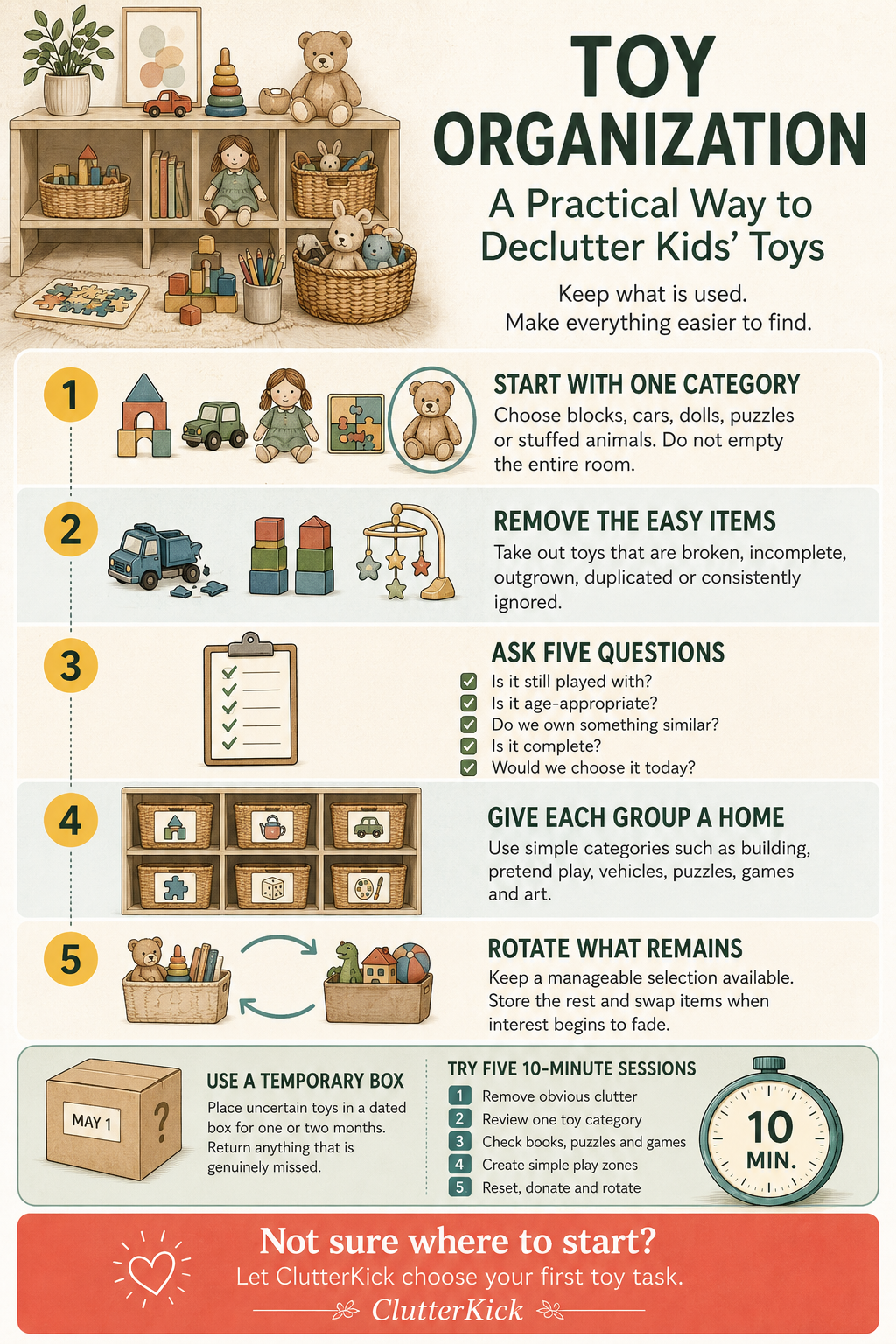
Start with one small toy category
Do not empty an entire playroom onto the floor unless you have enough time and energy to finish it. A room full of scattered toys can quickly turn a manageable task into an exhausting one.
Choose one contained category instead:
- Building blocks
- Toy vehicles
- Dolls and accessories
- Stuffed animals
- Puzzles
- Board games
- Art supplies
- Dress-up clothes
- Baby toys
- Outdoor toys
Bring together everything from that category. Check bedrooms, living areas, closets and any other place where toys tend to migrate.
Seeing the full category in one place makes duplicates and forgotten items much easier to spot.
03 / EASY DECISIONS
Remove the easy items first
Begin with decisions that require very little thought. Look for toys that are clearly ready to leave.
Remove anything that is:
- Broken beyond reasonable repair
- Missing important pieces
- Too worn to use
- An unwanted duplicate
- Part of a set that is no longer usable
- Consistently ignored
- Outgrown and unlikely to be used again
04 / DECIDE
Ask five questions about the toys that remain
The middle group is usually harder. These toys are not obviously broken, but you are unsure whether they are still worth keeping.
Pick up each item and ask:
- Does my child still play with this?
- Is it suitable for their current age and interests?
- Do we already own another toy that serves the same purpose?
- Is it complete enough to enjoy?
- Would we choose to bring this toy into our home today?
A toy does not need to be used every day to stay. Some puzzles, games and creative materials naturally come and go in phases. The important question is whether the item still has a realistic place in your child’s life.
05 / CHOOSE TOGETHER
Involve children in age-appropriate decisions
Children can take part in toy decluttering, but they do not need to make every decision.
Very young children may struggle to understand what donating a toy means. Older children can usually handle more responsibility, especially when the process is kept small and specific.
Instead of asking, “What do you want to get rid of?” try questions such as:
- Which three stuffed animals are your favourites?
- Which cars do you play with most?
- Are there any toys here that feel too young for you now?
- Which puzzle would you like another child to enjoy?
- If this basket could only hold ten toys, which ones would you choose?
Positive selection often works better than asking children to focus on loss. Choosing favourites feels clearer than deciding what to remove from a large pile.
06 / THE MAYBE BOX
Use a temporary box for uncertain toys
Some toys are difficult to decide on immediately. Rather than returning all of them to the shelf, create a temporary holding box.
Place uncertain toys inside, write the date on the box and store it somewhere out of the normal play area. Choose a review period that feels reasonable, such as one or two months.
If nobody asks for the toys during that time, the decision may become easier. If a particular toy is requested, return that item without reopening the entire box.
The temporary box should have a deadline. Without one, it becomes another permanent storage area filled with delayed decisions.
07 / CREATE HOMES
Organize toys according to how children actually play
Once you have decided what to keep, group the remaining toys by how they are used.
Practical categories might include:
- Building
- Pretend play
- Vehicles
- Dolls
- Animals
- Puzzles and games
- Creative activities
- Musical toys
- Outdoor play
The best toy organization system is one that makes sense without a long explanation. If a child can see where a toy belongs, there is a better chance it will return there.
08 / SET A BOUNDARY
Match the amount of toys to the available space
If stuffed animals have one basket, the collection should fit comfortably inside that basket. If toy cars have one drawer, the drawer should open and close without being forced.
The container is the boundary. When a category no longer fits, there are three choices:
- Remove a few items.
- Move the category to a genuinely better location.
- Decide that the category deserves more space than something else.
Buying another container should not be the automatic fourth choice.
Leave a little empty space where possible. A shelf that is filled to its absolute limit is difficult to use and could be difficult for a child to reset independently.
09 / KEEP IT SIMPLE
Make everyday toys easy to reach
Keep daily favourites in the simplest storage locations:
- Open shelves
- Low drawers
- Lightweight baskets
- Existing bins without complicated lids
- A small number of clearly defined play zones
Deep boxes often hide toys at the bottom. If you already own them, use each one for a single broad category rather than filling it with unrelated items.
Place heavier toys lower down and avoid stacking containers that children need to lift or move.
10 / LABEL CLEARLY
Use simple labels
Labels can help maintain toy organization, but they do not need to look elaborate.
For children who cannot read yet, use a picture of the toy category. A printed photograph, a simple drawing or a recognizable symbol is enough.
For older children, use short labels such as:
- Blocks
- Cars
- Dolls
- Games
- Art
- Dress-up
Make the label easy to see from the child’s normal height. The purpose is to make cleanup clearer, not to decorate the container.
11 / ROTATE
Create a toy rotation system
A toy rotation system allows you to keep some toys without having all of them available at once.
Choose a limited selection for the main play area, then place the rest in an existing closet, cupboard or high shelf. Rotate the selection every few weeks or whenever interest begins to fade.
A simple rotation might include:
- One building toy
- One pretend-play set
- A small selection of vehicles or dolls
- Two puzzles or games
- One creative activity
- A few favourite books
You do not need a strict calendar. The system should reduce clutter, not create another household obligation.
12 / KEEP MEMORIES
Handle sentimental toys separately
You may be keeping a toy because it was a first birthday gift, belonged to another family member or reminds you of a particular stage in your child’s life. That is a valid reason, but sentimental items should not be mixed into the active toy collection if they are no longer used.
Choose a limited keepsake space and store meaningful toys there intentionally. One carefully selected box is more useful than several containers that nobody has reviewed.
13 / FIVE SHORT SESSIONS
Try five 10-minute toy organization sessions
If the toy collection feels overwhelming, divide the work into five short sessions.
Remove obvious clutter
Collect broken toys, rubbish, empty packaging and unusable items.
Choose one toy category
Gather every item from one category and remove duplicates or outgrown toys.
Review books, puzzles and games
Check for missing pieces, damaged pages and items that no longer suit your child.
Create simple play zones
Group the remaining toys according to how they are used and assign each category a home.
Reset the room
Return stray toys, prepare donation bags and create a temporary box for uncertain items.
Five focused sessions can produce a meaningful change without requiring an entire weekend.
14 / KEEP IT CLEAR
How to keep toy clutter from returning
A good system should be easy to maintain during an ordinary week.
Try these simple habits:
- Reset one toy category before starting another.
- Keep a small donation bag in an adult-only storage area.
- Review toys before birthdays and holidays.
- Remove packaging as soon as a new toy is opened.
- Check incomplete sets before buying replacements.
- Use the same storage boundary for each category.
- Rotate toys rather than keeping everything available.
- Declutter obvious items whenever interests or age levels change.
15 / FREQUENTLY ASKED QUESTIONS
Frequently asked questions about toy organization
What is the easiest way to start organizing toys?
Start with one small category, such as toy vehicles or stuffed animals. Remove broken and outgrown items, then group what remains in one existing storage area. Avoid emptying the entire room at once.
How do you organize toys in a small space?
Limit each toy category to a specific shelf, basket or drawer. Keep frequently used toys accessible, rotate less-used items and avoid containers that are too deep for children to manage.
How often should toys be decluttered?
A quick review before birthdays, holidays and major age transitions is usually helpful. You can also remove broken or outgrown toys whenever you notice them instead of waiting for a full decluttering session.
ONE SMALL CATEGORY IS ENOUGH
A calmer toy collection is easier to enjoy
Toy organization is not about creating a showroom or removing everything your child loves. It is about making enough room for the toys that are actually used.
Start with one category, remove the obvious excess and give each remaining group a simple home. The room does not need to be perfect. It only needs to work better than it did before.
Not sure which area to tackle first? Let ClutterKick choose one small decluttering task and take it from there.
GET A MISSION One small decision creates space for the next one.