PAPER ORGANIZATION
How to Organize Paperwork at Home and Stop Paper Clutter
Learn how to organize paperwork at home, clear the visible piles and prevent new paper clutter from taking over.
Paper clutter has a way of spreading quietly. A few unopened letters land on the counter. Receipts collect in a drawer. School forms, bills and documents wait in separate piles because you are not sure where they belong.
Before long, dealing with paperwork feels like a much bigger job than it really is.
The solution is not an elaborate filing cabinet or a complicated color-coded system. You need a small number of clear decisions and one reliable place for each type of paper.
This practical method will help you organize paperwork at home, clear the visible piles and prevent new paper clutter from taking over.
01 / START SMALL
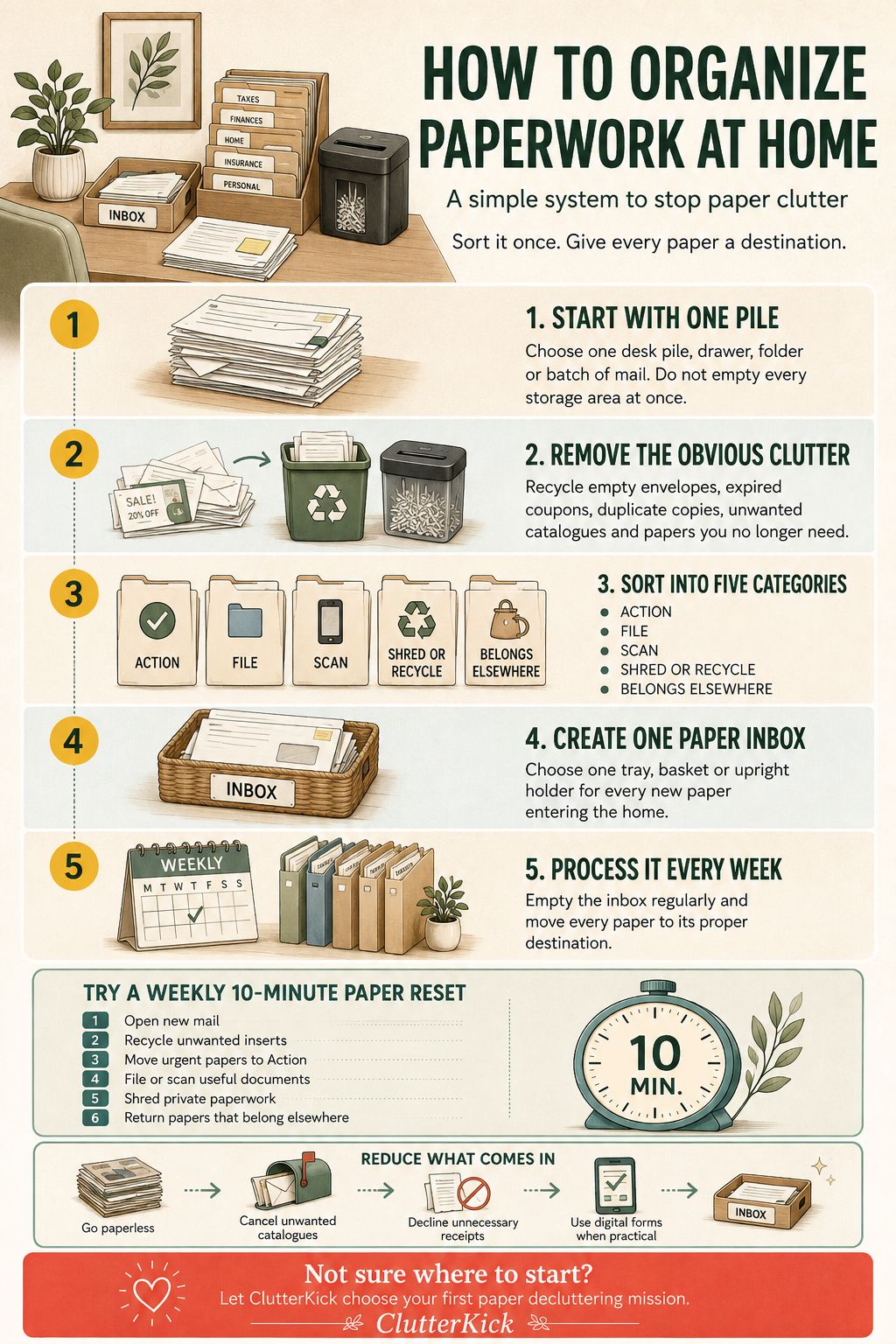
Start with one paper pile
Do not begin by emptying every drawer, cabinet and storage box in the house. That usually creates a larger mess and makes it harder to finish.
Choose one contained group of paperwork, such as:
- The pile on the kitchen counter
- One desk drawer
- The mail collected during the past month
- A single folder or document box
- The papers covering one section of your desk
Bring that group to a clear table and work only on what is in front of you. You can repeat the process with another pile later.
02 / EASY DECISIONS
Remove the obvious paper clutter first
Begin with the easy decisions. Recycle or discard items such as:
- Empty envelopes
- Expired coupons
- Duplicate copies
- Outdated flyers and catalogues
- Receipts you no longer need
- Instruction sheets for products you no longer own
- Notes that are no longer useful
03 / SORT
Sort paperwork into five simple categories
Once the obvious clutter is gone, give every remaining paper a destination. Five categories are enough for most households.
1. Action
These papers require you to do something. Examples include bills to pay, forms to complete, appointments to schedule and letters that need a reply.
Keep this group small and visible. An action folder hidden at the back of a cabinet is easy to forget.
2. File
These are documents you need to keep for future reference, such as insurance records, warranties, contracts and important household information.
3. Scan
Some papers are useful, but you do not need the physical copy. Scan them with your phone, save them in a clearly named digital folder and then recycle or shred the originals when appropriate.
4. Shred or recycle
This category is for papers that can leave your home. Keep shredding separate from ordinary recycling so private information is handled safely.
5. Belongs elsewhere
This includes school papers, work documents or forms that need to be returned to someone. Place them near the bag, door or workspace where they will be used.
If you cannot decide where a paper belongs, put it in a small review folder. Limit this folder to a reasonable size and return to it after the easier decisions are complete.
04 / ONE LANDING PLACE
Create one home for incoming paperwork
Paper clutter grows when new documents have no landing place. Choose one inbox for everything that enters the home.
It can be a shallow tray, an upright file holder or a simple basket. Place it where mail and loose papers naturally accumulate, not where you think they should accumulate.
The inbox is not permanent storage. It is a waiting area. Empty it at a regular time each week and move every item into action, filing, scanning, shredding or recycling.
Avoid creating several inboxes in different rooms. One central collection point makes it easier to see what needs attention.
05 / PREVENT
Reduce the amount of paper entering your home
Organizing existing paperwork helps, but preventing unnecessary paper is what keeps the system manageable.
Look for simple ways to reduce the flow:
- Switch suitable bills and statements to paperless delivery
- Cancel catalogues you never read
- Decline receipts when you do not need them
- Photograph short-term reference information
- Unsubscribe from unwanted postal marketing where possible
- Ask schools or organizations whether digital forms are available
Do not turn everything digital automatically. Some people remember tasks more easily when a paper is visible. The goal is to keep the format that works while removing the paper that adds no value.
06 / TEN MINUTES
Use a weekly 10-minute paper reset
Set a timer for 10 minutes and work in this order:
- Open the new mail.
- Recycle envelopes and unwanted inserts.
- Move urgent papers into the action folder.
- File or scan documents worth keeping.
- Place private papers in the shredding container.
- Return papers that belong in bags, offices or school folders.
Stop when the timer ends. If the inbox is not empty, continue during the next session. Consistency matters more than clearing everything perfectly each week.
07 / KEEPSAKES
What to do with sentimental papers
Cards, letters, children’s artwork and other meaningful papers need a different decision process. Do not mix them with bills and household documents.
Give sentimental papers a separate box with a physical limit. When it becomes full, review the collection and keep the pieces that still feel meaningful. You can photograph bulky or fragile items when the memory matters more than the original paper.
This is not about removing every paper from your life. It is about making sure the papers you value are not buried under things you forgot to recycle.
08 / FREQUENTLY ASKED QUESTIONS
Frequently asked questions about paper organization
What is the best way to organize paperwork at home?
Use one inbox for incoming papers, sort them into a few broad categories and schedule a short weekly reset. Keep action papers visible and store reference documents in clearly labelled folders.
How can I stop paper clutter from coming back?
Reduce unnecessary mail, use one collection point and process it regularly. Paper piles usually return when documents have no clear destination or when the system takes too much effort to use.
Should I scan all my paperwork?
No. Scan documents that are useful digitally and do not require an original copy. Keep important originals when necessary, and confirm retention requirements before discarding them.
Where should I start if I have years of paperwork?
Start with the newest and most visible pile. Recent papers are more likely to require action. Once the current paperwork is under control, work through older boxes in short, contained sessions.
ONE CLEAR DECISION
A calmer paper system starts with one decision
You do not need to organize every document in one afternoon. Start with one pile, remove the obvious clutter and give the remaining papers a clear destination.
Once every new paper has a place to land and a regular time to be processed, paperwork stops feeling like a permanent background task.
Not sure where to begin? Let ClutterKick choose one small decluttering mission and focus only on that next step.
GET A MISSION One small decision creates space for the next one.