KITCHEN ORGANIZATION
How to Organize Kitchen Cabinets and Keep Them Clutter-Free
Organize one cabinet at a time, make everyday items easier to reach and use the space you already have.
Kitchen cabinets can become cluttered surprisingly quickly. Mugs are pushed behind glasses, food containers lose their lids and rarely used appliances take up the easiest-to-reach shelves.
The problem is not always a lack of cabinet space. Sometimes too many unrelated items are competing for the same area, or the things used every day are stored in inconvenient places.
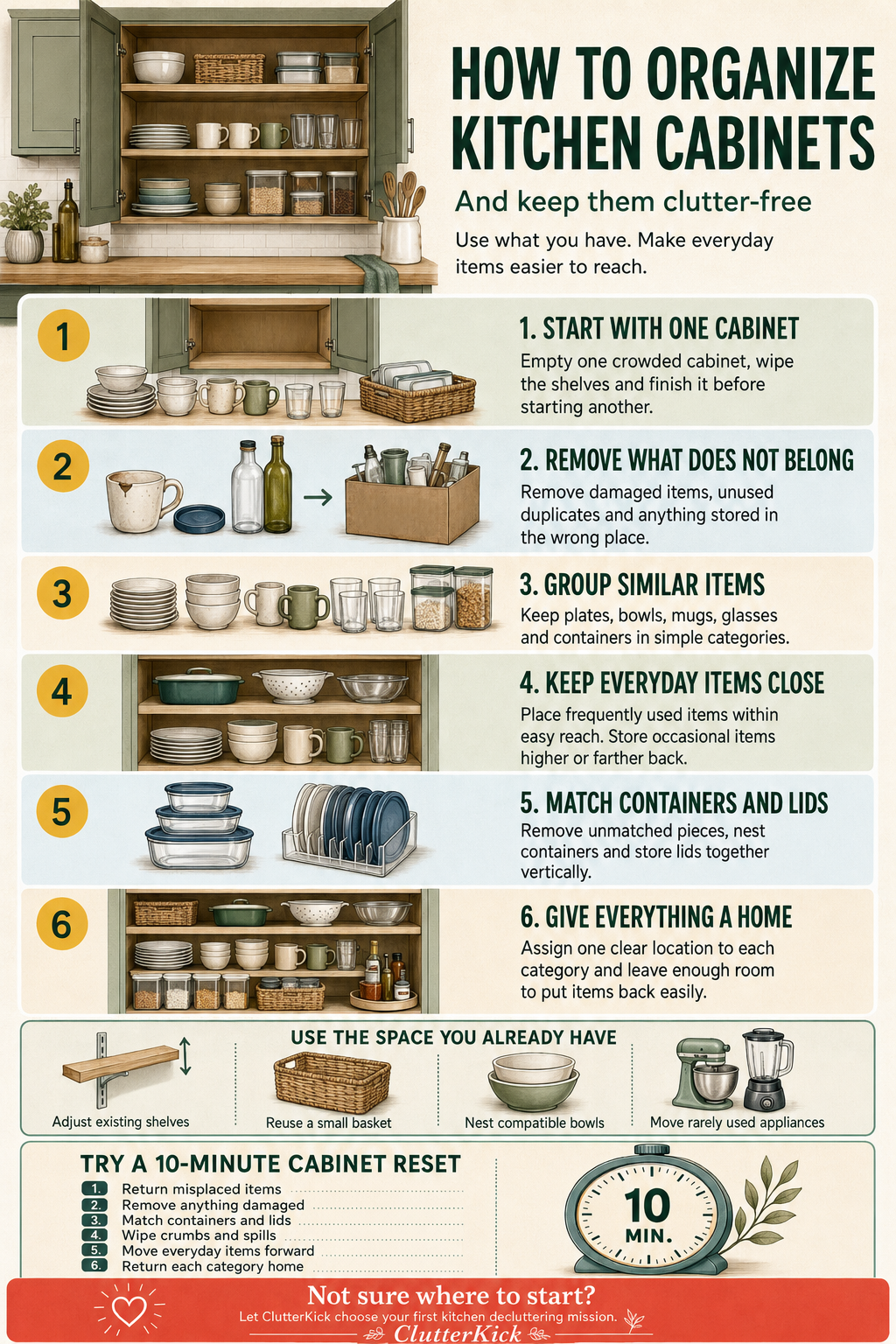
You do not need to reorganize your entire kitchen in one afternoon. Start with one cabinet, remove what does not belong and arrange the remaining items according to how often you use them.
01 / START SMALL
Start with one kitchen cabinet
Choose one cabinet that regularly feels crowded or difficult to use. It might be the cabinet containing mugs, plates, food containers, baking supplies or small appliances.
Remove everything from that cabinet and place it on a clear counter or table. Avoid emptying several cabinets at once. A single cabinet is easier to finish, and you will not leave the whole kitchen in disorder if you run out of time.
While the cabinet is empty, wipe the shelves and check for damaged liners, loose shelf supports or spills that need attention.
Do not start arranging anything yet. First, look at what the cabinet was holding.
02 / CLEAR THE EXCESS
Remove what does not belong
Begin with the easiest decisions. Look for items that are:
- Broken, chipped or badly damaged
- Missing an essential part
- Duplicated more times than you need
- Never used
- Stored in the wrong part of the kitchen
- Expired or no longer suitable to keep
- Difficult to reach but used frequently
Move items that belong elsewhere to their proper location. Set aside useful objects you no longer want for donation, and discard anything that cannot be safely reused.
Be realistic about duplicates. Having several plates or glasses makes sense. Keeping twelve reusable bottles when you regularly use only two may not.
The aim is not to own the smallest possible number of kitchen items. It is to give the things you genuinely use enough room to be stored properly.
03 / GROUP
Group similar items together
Once the obvious clutter is gone, sort the remaining items into broad categories.
Depending on the cabinet, your categories might include:
- Plates and bowls
- Cups and glasses
- Mugs
- Food containers
- Container lids
- Baking dishes
- Mixing bowls
- Serving dishes
- Small appliances
- Tea and coffee supplies
- Packaged food
Keep the categories simple. A system with too many detailed sections becomes difficult to maintain.
Grouping similar items also makes duplicates easier to notice. You may discover that several nearly identical bowls have been stored in different cabinets, or that you own more travel mugs than you realized.
Finish sorting before returning anything to the cabinet.
04 / EVERYDAY ACCESS
Place everyday items within easy reach
The best shelves should be reserved for the things you use most often.
Store everyday plates, bowls, glasses and mugs where they can be reached without stretching, bending deeply or moving other objects. Place occasional serving dishes, seasonal items and special cookware on higher shelves or toward the back.
Think about where each item is used. Mugs and coffee supplies may be easier to manage near the coffee machine. Plates and bowls may belong closer to the dishwasher or dining area. Baking dishes may be more convenient near the oven.
The most logical location is the one that reduces unnecessary movement during your normal routine.
05 / LEAVE ROOM
Avoid creating tall, unstable stacks
Stacking can save space, but very tall piles make cabinets frustrating to use. If you need the plate at the bottom, you should not have to lift a heavy tower every time.
Keep stacks at a manageable height. Separate different sizes when possible and avoid balancing small items on top of larger ones.
Leave a little open space around frequently used objects. Cabinets are easier to maintain when items can be removed and returned without rearranging the entire shelf.
06 / MATCH THE PIECES
Match containers with their lids
Food containers often create one of the most difficult kitchen cabinet areas.
Start by matching every container with a lid. Recycle or discard damaged containers and any lids that no longer have a matching base.
Choose one simple storage method:
- Store each container with its lid attached
- Nest containers and keep lids together vertically
- Group containers by shape or size
- Use one existing basket or box to hold loose lids
Do not keep an unlimited collection for possible future use. Decide how many containers your household regularly needs and allow the available cabinet space to set a reasonable limit.
Check this category regularly. Containers are easy to accumulate and difficult to manage once the collection becomes larger than the shelf.
07 / USE WHAT YOU HAVE
Use the space you already have
Before buying cabinet organizers, work with what is already available.
You may be able to:
- Adjust the height of existing shelves
- Reuse a small basket for lids or packets
- Use a spare box to group occasional items
- Place smaller bowls inside larger ones
- Move rarely used appliances to a less accessible cabinet
Organizers are most useful after you know what you are keeping and where it belongs. Buying baskets too early can leave you with more objects to organize rather than more usable space.
If a shelf still feels crowded after decluttering, measure it carefully before buying anything. Check the cabinet’s width, height and depth, and make sure the organizer will not block the door or make items harder to reach.
08 / ONE CLEAR HOME
Give every item a clear home
Each category should have one obvious location.
Try to avoid storing the same type of item in several cabinets. When mugs, containers or baking supplies are scattered across the kitchen, it becomes harder to see how many you own and easier to buy duplicates.
The system should also be clear to other people in the household. If someone needs a long explanation to understand where an ordinary plate belongs, the arrangement may be too complicated.
Labels can help inside food or baking cabinets, but they are not required everywhere. The position of the items should make the system understandable on its own.
09 / TEN MINUTES
Try a 10-minute cabinet reset
A short reset can prevent a cabinet from becoming difficult to use again.
Set a timer for 10 minutes and work in this order:
- Return misplaced items to their proper cabinets.
- Remove anything broken or no longer needed.
- Match food containers with their lids.
- Wipe visible crumbs or spills.
- Move frequently used items toward the front.
- Return each category to its assigned space.
Stop when the timer ends. You can choose another cabinet during a future session.
Regular short resets are usually easier than waiting until every kitchen cabinet needs attention at the same time.
10 / FREQUENTLY ASKED QUESTIONS
Frequently asked questions about kitchen cabinet organization
What is the best way to organize kitchen cabinets?
Group similar items together and place them according to how often they are used. Keep everyday dishes and glasses within easy reach, store occasional items higher up and avoid filling shelves so tightly that objects become difficult to remove.
How do you organize deep kitchen cabinets?
Keep frequently used items near the front. Place occasional items at the back in broad, clearly defined groups. Avoid stacking unrelated objects in front of one another because the items behind them will quickly be forgotten.
How can I organize kitchen cabinets without buying organizers?
Remove unused items, adjust existing shelves, nest compatible bowls and use spare baskets or boxes you already own. Organize first and buy a storage product only if a specific problem remains.
How often should kitchen cabinets be decluttered?
There is no fixed schedule. A short review every few months is usually enough for most cabinets. Food containers, mugs and frequently used food cabinets may need more regular attention because items tend to accumulate there.
START WITH ONE CABINET
A more useful kitchen starts with one cabinet
You do not need a perfectly organized kitchen to make everyday tasks easier.
Choose one crowded cabinet. Remove what does not belong, group similar items and give the things you use most often the easiest spaces.
Once every item has a clear home, putting things away becomes simpler and the cabinet is less likely to return to its previous state.
Not sure which area to tackle first? Let ClutterKick choose one small decluttering mission and focus only on that next step.
GET A MISSION One small decision creates space for the next one.